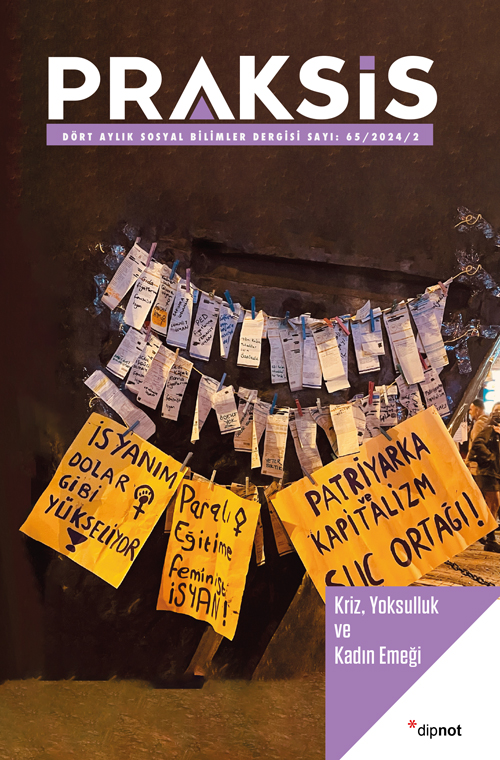

| Editors | Ezgi Pınar, Gökhan Demir, Hülya Kendir |
| Publication Secretary | Ümit Özger |
| Issue Editors | Aylin Topal, Cemil Yıldızcan, Cihan Özpınar |
In This Issue: Rationality and Irrationality within the Times of Crisis and Radical Transformations
Revolutionary Strategy Today
Cem Eroğul
The main pitfall to avoid in the search for an adequate revolutionary strategy is the tendency to duplicate the latest strategy adopted in the past, which in our case is the dictatorship of the proletariat. This is the result of two fundamental social-historic developments: 1) capitalism has outlived itself, and 2) the state is an oppressive mechanism having usurped the political powers of the people. So we need a radically new strategy. The preliminary basic step in the implementation of a revolutionary strategy is the elaboration and widespread adoption of a list of revolutionary principles and aims. For it is crucially important to develop a consensus concerning the kind of society that we are striving to build. Such a consensus can only be realized through a widespread and sustained discussion.
Keywords: State, strategy, community, revolution, capitalism
What Comes after Populism? Organizing within the Collapse
Agnes Gagyi
This article investigates paths forward after what many describe today as a failure of 2010s protests and ensuing projects of left populism. It summarizes main overlapping diagnoses of the 2010s wave of protest politics, which converge to conclude that protests’ spontaneous, horizontal mode of organizing did not allow for developing power to back demands; that these forms of organizing and protests’ ambiguous critique of status quo institutions reflected specific characteristics of middle class politicization; that new left populist projects that sought to valorize protests’ energy through electoral channels did not succeed in lack of deeper structures of organizing within social power relations; and that effects of 2010s protests tended to add to overall processes of repression, inequality and destabilization instead of solving them. A subsequent turn towards more substantive modes of organizing, presented in the second section of the article, has been seeking to amend those lacks, and put social power behind efforts to tilt the direction of profit-driven economic crisis and climate catastrophe. The article’s third section asks how new models proposed by this organizing turn relate to the current systemic shift from financializaton-driven crisis compensation of the neoliberal era towards global protectionism and geopolitical conflicts. As an orientative experiment, it lines out four strategic bifurcations to think through implications of new organizing directions regarding key issues like labor organizing, transitional planning, internationalism, and movements’ relation to systemic destabilization. What these bifurcations highlight in terms of an overarching problem of contemporary left organizing is that enhanced conflict capacity is unlikely to translate into enhanced capacity to accommodate needs of social reproduction. As an alternative direction of strategic bifurcations, the paper explores pathways and concrete examples of organizing frameworks that combine conflict capacity and constructive power, and acknowledge destabilization as a strategic environment.
Keywords: 2010s protests, left populism, organizing, labor, planning, internationalism
Revisiting Alienation and (In)Dignity: Theory and Ethnography
Yasemin Antik
This article revisits the Marxist concept of alienation by focusing on workers’ subjective experiences and their relationship with dignity under contemporary capitalism. Alienation is addressed not only as a structural condition rooted in capitalist production but also as a multilayered experience that is perceived, felt, and interpreted in everyday life. The article analyzes alienation through a tripartite framework: the objective organization of the labor process; the ontological ruptures in the individual’s relation to self, labor, and others; and the subjective experience of meaninglessness, devaluation, and emotional fragmentation. Grounded in ethnographic fieldwork among textile workers in “Yeni İstanbul Çarşısı,” the findings reveal that dignity may be constructed within alienated conditions, and at times, the pursuit of dignity may even intensify the structural dynamics of alienation. Furthermore, the article distinguishes alienation from mystification and indignity. Mystification is theorized as an ideological concealment that sustains alienation, while indignity refers to the affective ruptures caused by a lack of recognition and ethical regard, not necessarily reducible to alienation itself. In this respect, the article offers a comparative and context-sensitive analysis of these intertwined phenomena and aims to make visible their entanglements through ethnographic insight. Ultimately, the relationship between alienation and dignity is not conceptualized as linear or oppositional, but as a conflicted and historically contingent field of tension.
Keywords: Alienation, Dignity, Mystification, Ethnography, Working Class
The Relations of the Democratic Republic of Congo and Zambia with China: The Northernization of the South and the Limits of GreenTransition in a Capitalist Inter-State Structure
Barış Yentür
This study examines the limitations of the green transition within capitalist world economy throughthe relations of the People’s Republic of China with the Democratic Republic of Congo and Zambia. Despite its claim to combat the ecological crisis, the green transition instrumentalizes unequal power relations within the global economy and takes shape as a new capital accumulation strategy based on green mining. From this perspective, the unequal ecological and economic exchange established by China through its green transition strategy with peripheral countries, despite experiencing the pressures of the core-periphery hierarchy, reveals the complexity of asymmetric relations in the global system. China’s relations with the Democratic Republic of Congo and Zambia, despite the discourses of “ecological civilization” and “South-South cooperation”, reproduce traditional North-South colonial practices. These countries, located at the center of international green competition due to their rich mineral resources, are confined to the position of peripheral countries supplying raw materials, while China establishes a dominant position in the international division of labor, strengthening its green industry. Weak environmental policies and cheap labor make these countries attractive to Chinese capital, while unequal exchange deepens dependency relations. This study will analyze the intricate relationship between the climate crisis and global and class inequalities, exploring how green capitalism functions as a new form of fossil capitalism and contributes to the “Northernization” of the Global South.
Keywords: Capitalist world economy, unequal exchange, green capitalism, Northernization of the South, center-periphery relations.
Discussions for Restructuring in a “Triple Crisis”: Blurred Lines and Fault Lines Between Competing Green Imaginaries in Hegemonic Struggle
Başak Koşanay
The liberal productivity model that has been moulded into many different regulatory forms since the late 1970s under the hegemony of neoliberal socioeconomic paradigm is on the verge of a paradigmatic transition facing with a Triple Crisis, namely the accumulation crisis, legitimacy crisis and ecological crisis. In this interregnum, alternative strategies of accumulation with a ‘greener’ outlook were developed, to simultaneously address all the pillars of the Triple Crisis to become the hegemonic imaginary, and growth critical perspectives against them, such as degrowth.
In this regard, this paper will discuss degrowth in comparison with capitalist green imaginaries of the Global North. The aim here will be to unravel these strategies in their potential to overcome the Triple Crisis and how they challenge or reproduce the existing structures via their prospective political economic designs in a struggle to become the hegemonic imaginary. Accordingly, the possibility of green capitalist imaginaries to hijack degrowth in the process of political struggle and what kind of strategy degrowth can pursue in response to them will be discussed.
To do so, this paper will employ the theoretical framework of the Regulation Approach (RE) such as techno-economic paradigm, mode of regulation and mode of socialization as the theoretical framework and the methodological framework of “variation-selection-retention approach” of the Cultural Political Economy (CPE) literature as well the “morphogenetic and morphostatic approach” of critical realism as the methodological framework.
Keywords: Degrowth, Triple Crisis, Green New Deal, Regulation Approach, Transformation Degrowth, Triple Crisis, Green New Deal, Regulation Approach, Transformation
Crisis and Postponement Mechanisms: The Irrationality of “Returning to Rational Policies” in Turkey
Gizem Şimşek
The current crisis of capital accumulation in Turkey has deepened through various postponement mechanisms that shape the relationship between process and intervention. The rational decisions that the political power promptly implemented against the crisis have strengthened the irrational tendencies of the crisis. The constant change in the “rational” decisions made by the economic management that started operating after the 2018 general elections has increased the social burden of the crisis. Two of the “rational” decisions taken to postpone the crisis at the stage of capital accumulation come to the fore: One of these is the Türkiye Economy Model implemented as of September 2021, while the other is the policies that stand out with the discourse of “returning to the rational ground” after the 2023 elections. These two models, which complement each other and increase the impasses of the crisis, reveal the contradictions of the process that reveal the inner connections between capital accumulation, the state and political power in Turkey. The study is based on the idea that the political power in Turkey has turned to short-term interventions to overcome the tensions created by the obstacles inherent in production relations. In this context, the main argument of the study is that these interventions, instead of overcoming the crisis, further strengthen the crisis tendencies and cause them to become permanent. The study simultaneously draws attention to the fact that the political power tries to maintain its current political position with short-term postponement mechanisms that it uses to overcome the crises triggered by the dependency on imported inputs and the capital need in the form of foreign exchange. In this context, the study emphasizes that the crisis postponement mechanisms integrated with an “irrational” discourse of “returning to the rational ground” make the contradictions of capitalism in Turkey more visible and aims to show that the social burden of these contradictions falls on the whole society from a class perspective, but more on the working class.
Keywords: Capital accumulation, crisis, late capitalistization, capital need in the form of foreign currency, irrationality, rational policies.
Reading Neoliberal Crises with Crime Frames: Grief Activism after 2023 Maraş Earthquakes
Nazlı Bülay Doğan
The crisis of neoliberalism manifests itself in different areas of society. It becomes most visible especially in cities, through the experiences of the families of those who lose their lives during crises, accidents, and natural disasters. These are crimes of the powerful, which hide behind the rhetoric of “unwanted, tragic accidents.” In Turkey, the most critical manifestation of these crimes in the city has been the earthquakes that claimed the lives of hundreds of thousands. Following the 2023 Maraş Earthquakes, this study investigates how the justice struggles of grieving families have been shaped through social media, analyzing through crime frames used by these actors. It examines which crime frames the families use regarding the earthquake, the relationship of these frames to neoliberal crises, and the place of these frames both in mourning processes and in their struggles, based on their posts on the Twitter (X) social media platform. Through this examination, the framing of the earthquake damage by the families in line with the conceptualization of “the crimes of the powerful,” the central place of this crime frame within their struggle discourse, and the components of the neoliberalism critique within the disclosure of the crime are discovered.
Keywords: Neoliberal crisis, crimes of the powerful, crime frames, grief activism
Round Table: Rationality, Irrationality and Political Strategy
Ali Yalçın Göymen, Demet Dinler, Panagiotis Sotiris